
Compare Allegany County Supervision
Maryland separates the body that grants parole from the agency that supervises a person in the community. The Maryland Parole Commission makes parole decisions within its authority. The DPSCS Division of Parole and Probation, known as DPP, provides field supervision for parole, mandatory release, probation, and other assigned statuses. A court controls probation. DPP administers the terms but does not turn probation into parole.
| Question | Parole | Probation |
|---|---|---|
| Who authorizes it? | Maryland Parole Commission under the governing sentence and statutes | The sentencing court through its order |
| When does it apply? | After release from a prison sentence, subject to conditions | As a court-ordered sentence or part of a sentence in the community |
| Who supervises locally? | Maryland DPP for state parole | Maryland DPP when assigned to state field supervision |
| Best verification record | Written parole decision, release record, and DPP assignment | Court docket and order, plus DPP assignment when applicable |
| How does it end? | Discharge, maximum expiration, or other lawful termination | Court completion, discharge, or another order |
The phrase “released” describes physical departure only after that event occurred. A favorable parole recommendation, hearing date, or approval can come earlier. Home-plan review, programs, conditions, a detainer, or processing may still stand between the decision and the gate. Probation may start without a state-prison release at all, such as after a county court disposition.
- Parole
- Conditional community release from a prison sentence under parole authority.
- Probation
- Court-ordered supervision in the community, either instead of or after confinement.
- Mandatory release
- Conditional state release based on the sentence and applicable diminution credits, with supervision continuing as law provides.
- Discharge
- The formal end of a supervision term or legal obligation shown by the controlling record.
- Absconder
- A formal status based on an official supervision record, not a guess drawn from missed contact.
Verify Allegany County Post-Release Supervision
Maryland has no general public name-by-name roster that should be described as a complete probation or parole lookup. The Allegany County current-inmate portal is also the wrong tool once someone has left the jail. Its results list people “currently held,” not people supervised in the community. Verification must follow the record that created the supervision term.
- Identify the release system. County-jail departure, Maryland prison release, and federal prison release lead to different supervision records.
- For probation, open the Allegany County case in Maryland Judiciary Case Search and read the docket, sentence, and later violation entries.
- For state parole, confirm the Maryland Parole Commission decision, then obtain the DPSCS release record rather than treating approval as the release date.
- Use the DPP office directory to identify the likely supervising office. Ask whether staff can verify the assigned office or direct the inquiry to the proper custodian.
- Use the person’s release or supervision paperwork when available. It may state the office, conditions, dates, and state identifier.
- For durable proof, request the existing court, parole, release, or completion record from the office that created it.
Match full name with a court case number, date of birth where lawfully available, or DPSCS identifier. Common names can cause false matches. Office staff may protect addresses, contact details, victim information, investigative data, and other nonpublic content. A limited response does not prove that no supervision exists.
The Allegany County released inmate search covers the custody side in full, including county release transactions, state records requests, court dockets, VINE, and federal locators.
Allegany County Supervision Office
The official Maryland directory lists the Cumberland Field Office/DDMP for local field routing. The directory is an office locator, not a public supervision search. Call to ask whether staff can confirm the assigned office or identify the correct records custodian. No public office hours were supplied in the research, so confirm before visiting.
Cumberland Field Office/DDMP123 South Liberty Street
Cumberland, MD 21502
Phone: 301-784-8110
Fax: 301-722-6976
Hours: Call to confirm
The official DPP office directory supplies the Cumberland supervision route.
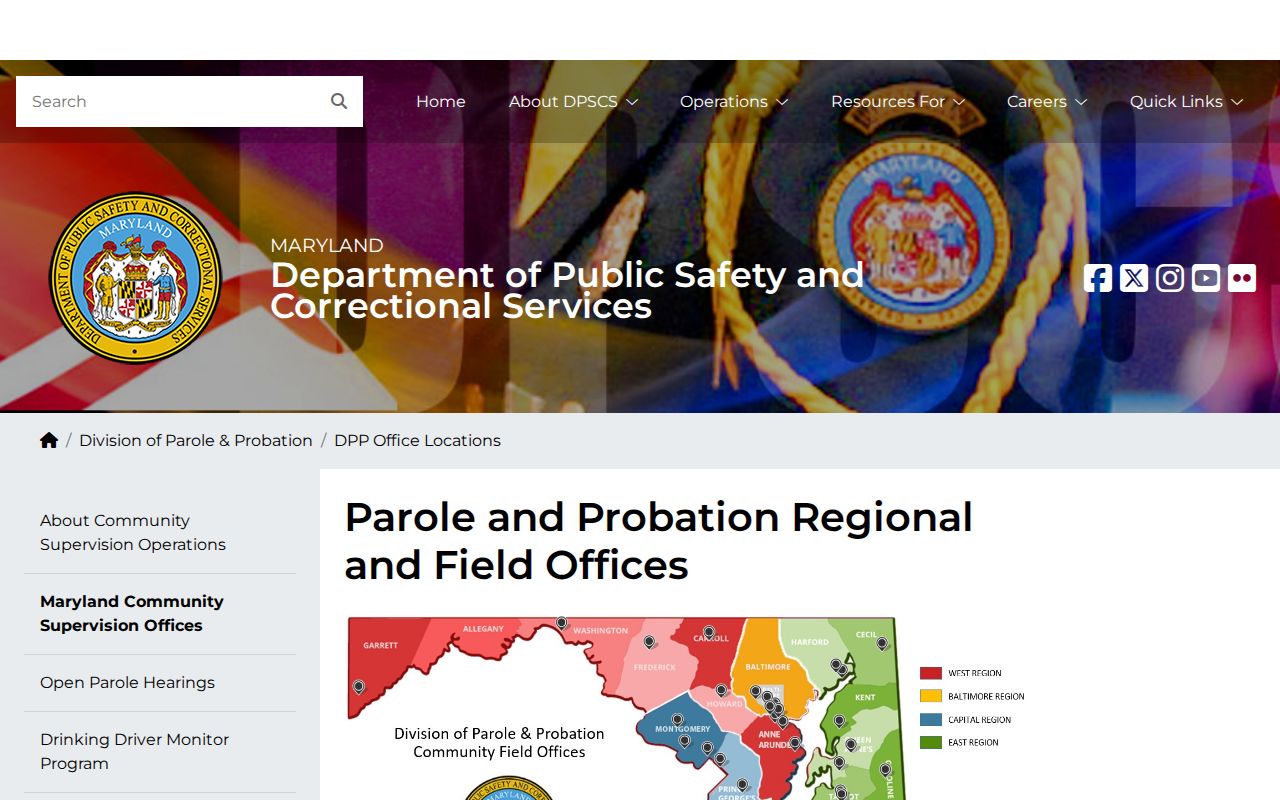
The directory confirms where an Allegany County supervision inquiry can start. It does not reveal whether a named person is on parole or probation. DPP’s central Operations contact is 6776 Reisterstown Road, Baltimore, MD 21215; 410-585-3500; dpp.info@maryland.gov. Use the central route when the local office cannot identify the correct custodian.
Note: Protect nonpublic home, victim, and contact details when asking an office to verify an Allegany County supervision assignment.
Allegany County Reentry Preparation
The Allegany County Detention Center employs a re-entry coordinator. The official facility page describes case management and referrals for people completing jail sentences. It names practical preparation such as season-appropriate clothing, birth certificates, Social Security cards, and medical help. These services can support a transition into probation or another lawful release plan, but the page does not state that every released person receives each service.
Reentry aid and legal supervision should not be merged. A coordinator can help with practical needs and referrals. A court order or DPP record controls probation, while parole paperwork and DPSCS records control state parole. Sheriff Craig Robertson’s Detention Center staff document the local custody event. DPP documents the assigned state supervision. Each source answers a different part of the timeline.
People leaving North Branch Correctional Institution or Western Correctional Institution use the state release and supervision process. Someone leaving FCI Cumberland enters a federal pathway, where supervised release is imposed through the federal court and managed by the federal probation system. The county re-entry coordinator is not the custodian of those state-prison or federal records.
IDs After Allegany County Release
Foundational documents matter after release. The Detention Center’s published re-entry work includes help requesting birth certificates and Social Security cards, along with suitable clothing and medical support. That local detail is useful when a person must report to supervision, follow a court plan, or correct the identity data attached to a record.
A correction request must go to the source of the error. For a county booking or release transaction, contact the Sheriff or Detention Center custodian with the inmate number and booking or release dates. An error in a disposition belongs with the District or Circuit Court clerk that keeps the case. A state sentence calculation or DPSCS custody error belongs with DPSCS. The DPP office should address its own supervision record.
Do not collapse those tasks into one broad dispute. The court cannot rewrite the Sheriff’s transaction log, and the jail cannot change a judicial disposition. A focused request should identify the exact field, the supporting document, and the office that created it. This keeps Allegany County parole and probation records aligned with the release and court records they rely on.
Note: Keep copies of completion papers, release documents, and corrected identity records because public web tools may not preserve former-custody results.
Three Allegany County Supervision Systems
Allegany County contains three adult release paths within a small area. A person can leave the county jail on probation, leave NBCI or WCI on state parole or mandatory release, or leave FCI Cumberland for federal supervised release. Geographic closeness does not merge these systems. The agency and judgment determine which record to use.
| Release path | Supervision authority | Primary verification |
|---|---|---|
| Allegany County Detention Center to probation | Sentencing court and Maryland DPP when assigned | Court order, jail release transaction, and DPP office |
| NBCI or WCI to parole or mandatory release | Maryland Parole Commission where parole applies; Maryland DPP for field supervision | MPC decision, DPSCS release record, and DPP assignment |
| FCI Cumberland to supervised release | Federal court and U.S. Probation Office | BOP release result, federal judgment, and federal supervision record |
A transfer out of one institution is not always community release. A person gone from NBCI may still be in DPSCS custody elsewhere. A BOP “Released” result means the person left BOP custody, but another sovereign could then hold the person. A county jail movement can likewise end local custody while a detainer sends the person to another agency.
Maryland VINE can report events from participating custodians and supports phone, email, text, TTY, or app delivery as offered. It does not decide the court case. DPSCS also warns that VINE does not notify users of every transfer between state institutions. Reconcile any alert with the release transaction and supervision authority.
Allegany County Parole Hearings
A parole hearing date, decision, and actual release are separate milestones. The Maryland Parole Commission’s landing page links commission material and public meetings. It says public meetings occur every other Wednesday at 9:30 a.m., but those meetings are not a calendar of every person’s parole hearing. The linked open-hearing master list reviewed in the research ran only from January through May 2025 and was stale by July 2026. Open hearings are a subset, not a complete statewide docket.
The Commission identifies three common decisions. “Refuse” means no further hearing. “Rehear” sets a future review point. “Approve” remains subject to release processing and any stated terms. An approved home plan, required program, other condition, detainer, or further review may delay departure. Confirm the written decision, then confirm the physical release through DPSCS.
Conditions can govern reporting, movement, treatment, payment, conduct, or other duties set by the controlling order. Their precise terms come from the person’s papers and official record. A violation can lead to court action, a warrant, or parole retake process. Yet a missed appointment, rumor, or unavailable web result does not establish absconder status. Use an official warrant, court, Commission, or DPP record.
The Maryland Judiciary Case Search can show probation orders and later violation proceedings for many cases. It is an index, not the official court file, and entries can lag. Obtain the clerk’s record when exact legal proof is required.
Ending Allegany County Supervision
Supervision ends through the event stated in the controlling record. Parole eligibility does not end supervision. Neither does parole approval. A state prisoner on parole or mandatory release may remain under legal conditions through a later date. Probation ends under the court’s order and any lawful completion or discharge process. Federal supervised release follows the federal judgment, not Maryland DPP practice.
A former Maryland supervisee who successfully completed probation, parole, or mandatory-release supervision may request a Certificate of Completion from DPP. The policy reviewed in the Allegany research says a request can be made by any medium and DPP responds within 15 working days. That certificate is a focused way to document successful completion. It should be read with the court or parole record when the exact term and authority matter.
For an older or disputed record, request the existing DPP completion record, court disposition, parole paperwork, or DPSCS discharge document. General Provisions Article, Title 4 governs Maryland public-record requests, subject to exemptions. Ask for nonexempt portions and a written legal basis for any denial. Do not infer discharge merely because a public search no longer returns the person.
Final verification is simple in principle: identify the system, obtain the order that created supervision, confirm the assigned office, and obtain the record that ended it. That sequence preserves the distinction between leaving custody and completing all legal supervision.