
Projected Versus Actual Allegany Release
A projected release date is a forward-looking calculation. It estimates when custody may end if the current sentence, credits, court orders, and other legal conditions remain in place. An actual release date records an event that has already happened. Those dates serve different purposes. A maximum expiration date also differs because it marks the end point derived from the sentence calculation, while parole eligibility only marks when parole may be considered.
Custody status matters first. Someone held before trial at the Allegany County Detention Center has no sentence-based release date unless a sentence already applies. Bond, recognizance, a court release order, dismissal, or later commitment can control the next step. A sentenced county detainee may have a local computation. A prisoner at NBCI or WCI has a Maryland DPSCS computation. FCI Cumberland follows federal rules. None should be substituted for another.
Scheduled versus actual: A future date may move, and only the completed release or discharge transaction proves that custody ended on a specific date.
A transfer is not community release. A detainer, meaning a request or legal basis for another agency to take custody, can move someone directly from one institution to another. Parole approval is not the gate time either. Release planning, conditions, another sentence, or a hold may still prevent departure.
Find an Allegany Projected Release Date
There is no one public Allegany County screen that supplies a dependable projected date for every custodian. Begin with the signed commitment and court docket. Those records identify the sentence, its start, concurrent or consecutive terms, and credit ordered for prior custody. Then direct the question to the agency that is doing the calculation.
- Identify the current custodian: Allegany County Detention Center, DPSCS, BOP, or another agency.
- Find the signed sentence or commitment and review the related Maryland court docket.
- Separate pretrial custody, a local jail sentence, and a state prison sentence.
- Confirm concurrent or consecutive structure and presentence custody credit.
- Ask the custodian for the existing sentence calculation and its current projected or maximum date.
- Check for parole action, detainers, new sentences, or court amendments that affect the date.
- After departure, obtain the actual release or movement transaction.
For the county jail, call the Allegany County Detention Center at 301-729-8540 or request the disclosable commitment and calculation record. Sheriff Craig Robertson’s office operates the facility through its Corrections Division. For a state prisoner, use the DPSCS public-information route and name the person and state identifier if known. The Allegany County release search paths provide the broader checks needed when the custodian itself is uncertain.
Note: A pretrial bond block can describe release conditions, but it does not create a fixed release time or resolve the criminal charge.
Allegany DPSCS Release Field Limits
The DPSCS Incarcerated Individual Locator is not a former-prisoner history. Its visible public inputs are first and last name, and its stated purpose is to supply institution information for covered people currently in custody. DPSCS expressly says those no longer in custody for any reason, including release or escape, are not listed. It also warns that the tool does not include everyone in its custody.
No official source reviewed established a public projected or tentative release-date field in that locator. The county portal also does not show one. Its active detail record shows booking date and time, status, bond, and charges, while its results are headed “List of Inmates Currently Held.” A missing record from either tool cannot supply a future date or prove lawful release. The official DPSCS locator page displays that current-custody limitation.
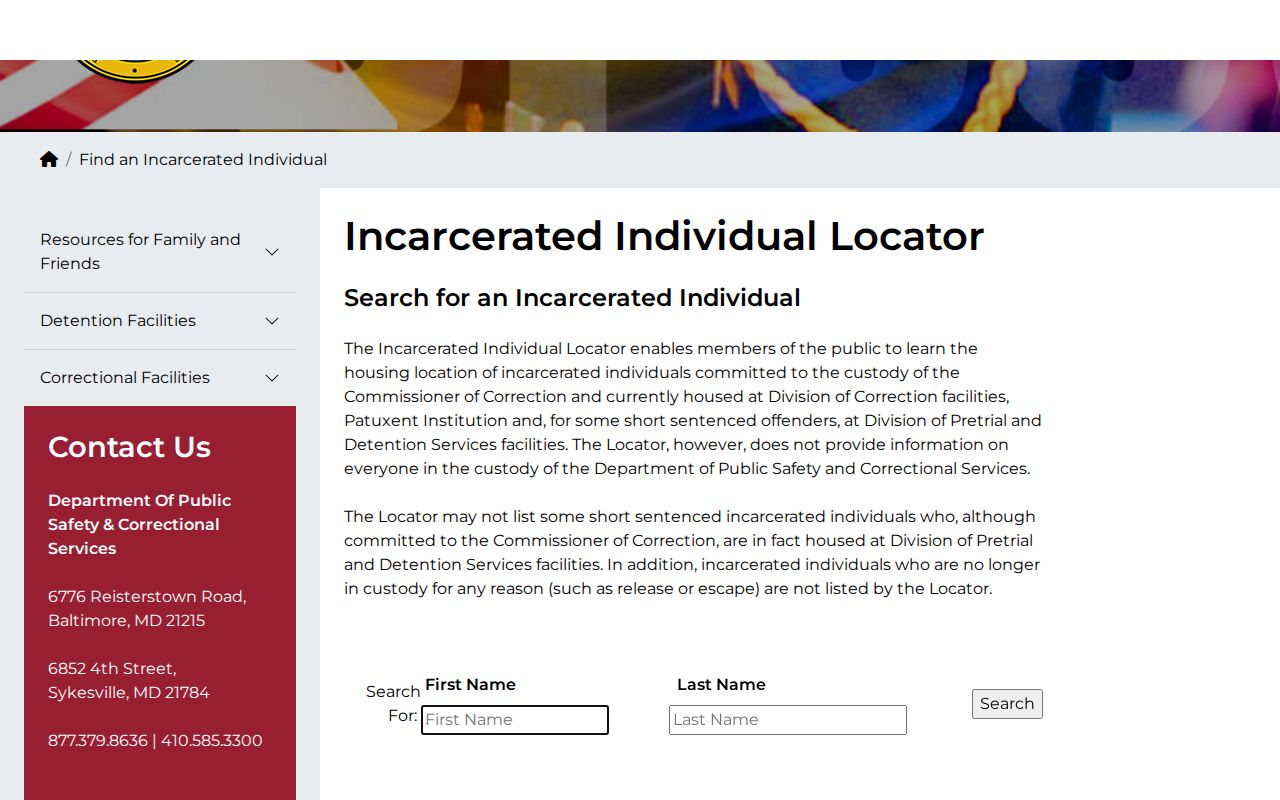
The screen is useful for locating a covered incarcerated person, but the full state sentence calculation must be obtained through the proper DPSCS record channel.
For documentary confirmation, the DPSCS Public Information Act process can be used to request an existing custody summary, sentence-calculation fields, actual discharge date, and release mechanism that are disclosable. DPSCS identifies dpscs.pia@maryland.gov and its PIA Coordinator at 6776 Reisterstown Road, Baltimore, Maryland 21215-2318. The first two search and preparation hours are free; listed charges may apply after that point.
Maryland Credits Shape Allegany Release Dates
Maryland calls sentence reductions “diminution credits.” For state prisoners, the main framework is Correctional Services Article, Title 3, Subtitle 7. The calculation starts with the sentence and lawful commencement date, applies credit for prior custody, combines terms as required, and then accounts for credits that were earned and retained. Good conduct, work, education, and special projects can each have distinct rules. A headline monthly rate is not enough to calculate one person’s date.
For sentences imposed on or after October 1, 2017, CS §3-704 generally provides five days of good-conduct credit per calendar month for a term that includes a defined crime of violence or specified drug offense, and ten days per month for other covered terms, subject to exclusions. Section 3-705 addresses work credit, while §3-706 addresses education and program credit. Special-project credit, caps, and revocation or restoration are governed by their own provisions.
Eligibility depends on the offense, act date, sentence date, commitment, and statutory exclusions. CS §3-702 contains key eligibility limits. Presentence credit is addressed by Criminal Procedure §6-218. Credits shown in a working estimate must be those actually awarded and not later revoked.
Maryland has no blanket rule that every prisoner must serve 85 percent. That federal shorthand should not be imported into an Allegany County calculation. Under CS §7-301, parole eligibility depends on the sentence, offense, act date, mandatory terms, and detailed exceptions. Eligibility is only the point when parole may be considered. It does not mean approval, and approval does not itself prove release.
Allegany County Release Credit Rules
A county sentence at the Allegany County Detention Center must be calculated under the local correctional-facility rules and the actual commitment. The state-prison Title 3 rate cannot be copied onto a local sentence. CS §11-503 addresses presentence good-conduct credit for a local correctional facility at five days per calendar month, prorated, and specifies when that credit ends. Section 11-504 addresses postsentence good conduct.
| Custody setting | Primary date source | Key caution |
|---|---|---|
| Pretrial county detention | Court orders, bond status, and jail custody record | No fixed sentence-based release date may exist. |
| Local Allegany sentence | Signed commitment and Detention Center calculation | Use local Title 11 credit rules, not state-prison rates. |
| Maryland state prison | DPSCS sentence computation and commitment | The public locator does not publish a projected-date field. |
| Parole or mandatory release | MPC decision, DPSCS record, and DPP supervision record | A hearing or approval can precede physical release. |
| Federal custody | BOP and federal court records | Maryland county and DPSCS calculations do not control. |
A mandatory supervision release date is a Maryland administrative calculation, not a public locator field. COMAR 12.02.06.01 defines it as maximum expiration less applicable credits. Under CS §7-501, a covered person can be conditionally released when the statutory point is reached, but remains under legal custody and conditions through maximum expiration. That continued status is why physical release and final discharge must not be treated as the same event.
A sound Allegany County calculation keeps each step visible. Start with the signed term and lawful start date. Mark whether multiple terms run at the same time or one after another. Add the presentence credit shown by the court or required by law. Then apply only the local or state credits earned under the right statute. Parole eligibility and mandatory supervision are separate layers, so neither should be silently folded into a guessed date. If the jail or DPSCS record produces a different result, ask for the calculation inputs and correction route rather than treating an informal estimate as official.
Why Allegany Release Dates Change
A projected date is recalculated when one of its inputs changes. Some changes shorten the expected term, while others extend it or prevent community release. The responsible custodian’s current calculation controls. Hand calculations are useful for spotting a question, but not for declaring an official date.
| Change | Possible effect | Where to verify |
|---|---|---|
| Credit earned or restored | May move a calculated date earlier if lawfully applied. | Custodian sentence-computation record |
| Disciplinary credit revocation | May move the date later. | Institutional credit and disciplinary record |
| New sentence or detainer | May add custody or cause direct transfer. | Court docket and receiving agency |
| Sentence amendment or appeal | May alter the term, start date, or credit. | Signed court order and updated computation |
| Jail-credit correction | May move the date in either direction. | Court and custodian calculation |
| Parole decision | May permit conditional release after required processing. | Maryland Parole Commission and DPSCS |
| Data correction or escape time | May change the administrative calculation. | Official custody record |
A parole hearing date, a favorable recommendation, and an approved home plan are separate milestones. The Maryland Parole Commission makes parole decisions, while the DPSCS Division of Parole and Probation supervises covered people in the community. Conditions, required programs, a detainer, or added review can leave time between a decision and actual departure.
Note: Compare the offense, act date, sentence date, and commitment before applying any Maryland credit or parole rule to an Allegany County case.
Confirm Allegany Actual Release Dates
Near an expected county release, call the Allegany County Detention Center and check the Maryland court docket for the controlling order. For a state prisoner, ask DPSCS for the current computation through the correct record channel. A current locator result can identify a covered institution, but a later missing result cannot state why the person disappeared.
Maryland VINE is most useful when registration occurs before the event. The Allegany County VINELink check explains how to select the correct person, register a phone or electronic alert, and preserve the exact status language. A VINE notice remains secondary to the jail or DPSCS transaction because automated data can lag and a custody change may be a transfer.
After the expected date passes, obtain the completed release, discharge, or movement record. For an Allegany County detainee, ask for the release date and time, authority, release type, and receiving custodian if the person transferred. For a Maryland prisoner, ask DPSCS for the actual discharge date, institution of release, release mechanism, and relevant sentence-calculation fields. The historical event record is the final test of whether the projected date became the actual one.